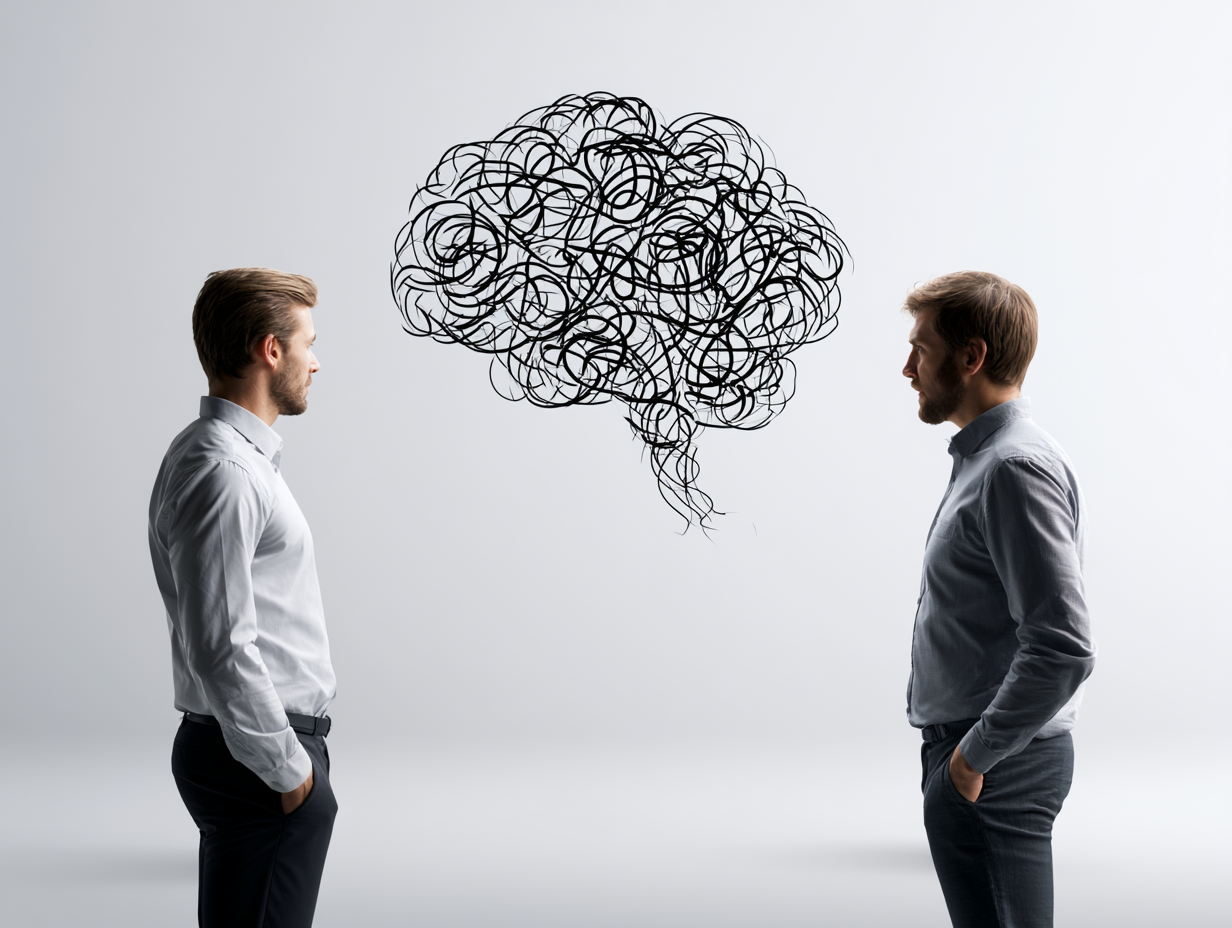
When most men hear ’emotional intelligence,’ something in them resists. The phrase has been culturally packaged in a way that implies softness, over-processing, an endless loop of feelings conversations. And for a man who values clarity, competence, and directness, that sounds less like a skill and more like a personality he does not want.
So let’s reframe it — because emotional intelligence has almost nothing to do with how sensitive you are. It has everything to do with how accurate you are.
What Emotional Intelligence Actually Is

Emotional intelligence is the capacity to accurately read and respond to emotional data — in yourself and in others. The operative word is accurately. This is fundamentally about precision, not sentimentality.
Think of it this way: emotions are information. They are signals in your nervous system telling you something about your environment, your values, your needs, your relationships. A man with high emotional intelligence is not more weepy or verbose. He is better at reading the information his internal systems are generating — and using it effectively.
A man who cannot access his emotional data is not stoic. He is running his relational life blind.
” Emotions are information. Emotional intelligence is the capacity to read that data accurately. It is a skill, not a personality type. “
The Competence Gap Most Men Don’t Know They Have

Most men are taught to manage emotion, not read it. Push through it, suppress it, convert it into action. The result is a competence gap that shows up most acutely in relationships.
She says you are emotionally unavailable. You say you are just not that expressive. But here is the real dynamic: she is reacting to your emotional data — the signals you are sending through your tone, your withdrawal, your defensiveness, your silence. You are just not reading those signals yourself.
The problem is not that you are feeling things and not saying them. The problem is that you have not been trained to identify what you are feeling in the first place. There is often a significant lag between an emotional event and any internal recognition of it. By the time it surfaces, it comes out sideways — as irritability, shutdown, or distance.
The Four Deficits That Show Up in Relationships
1. Alexithymia — Not Knowing What You Feel
A substantial proportion of men experience some degree of alexithymia — difficulty identifying and describing emotional states. Something happens, there is a physical sensation, but the bridge between that sensation and a named emotion does not exist. ‘I am fine’ is not a defensive response — it is sometimes an honest report of a man who genuinely cannot locate what he is experiencing.
Developing emotional vocabulary is not about being more talkative. It is about building the internal architecture to identify what your system is registering, so you can respond with more precision.
2. Protest Behaviours Disguised as Neutrality
When a man feels criticized or flooded, the typical response is withdrawal or shutdown. He goes quiet. He leaves the room. He says he needs to think about it. This often reads to his partner as not caring. What is actually happening is that his nervous system is in threat mode and his strategy is to shut down.
The problem is that withdrawal is also a communication — and it is usually received as rejection. Understanding what your system is doing under pressure, and developing more conscious responses, changes the relational dynamic fundamentally.
3. Converting Emotion to Anger
Anger is often the one emotion men are given permission to express. So a significant range of emotional experience — hurt, fear, shame, grief, loneliness — gets converted into anger before it surfaces. You do not feel scared; you feel pissed off. You do not feel rejected; you feel furious.
The anger itself is not the problem. The problem is that the original emotion never gets addressed, the information never gets used, and the relationship receives the anger without the context that would make sense of it.
4. Impact vs Intent Confusion
Most men are highly focused on intent. I did not mean it that way. I was not trying to hurt her. And that is true — but it is irrelevant to the impact on the other person. High emotional intelligence means being able to hold both: your intention was clean, and the impact was real. Both matter.
” Most men optimise for intent. But relationships operate on impact. Developing the ability to hold both is a fundamental shift. “
Why This Matters — Beyond Relationships
Emotional intelligence is not just a relational skill. It is a leadership competency, a negotiation asset, a pressure management tool. The men who perform best under sustained high-stakes pressure are not the ones who feel the least — they are the ones who can read and regulate their internal states most accurately.
The literature on high-performance is unambiguous on this: emotional regulation predicts performance better than intelligence in complex, interpersonal environments. This is not soft skills. This is competitive advantage.
Building the Skill

Emotional intelligence can be developed at any age. It requires three things: the capacity to notice (what is happening in my body right now?), the vocabulary to name it (what emotion might this be?), and the willingness to use it (what does this information tell me I need?).
This is not therapy. It is training. The same way you built competence in any other domain — with practice, feedback, and honest assessment of where the gaps are.
—
Individual coaching for men at MOI Coaching focuses on developing this exact competency — not as an emotional project, but as a structural one. The coaching page has more on what this work looks like.
── ── ──
